I was not expecting to like "Big Hero 6" as much as I did. The prospect of eating pancakes during the 9:00 AM showing of this film during its opening weekend was much more exciting than seeing the film, which looked interesting from the trailer, but, as I have not had much luck enjoying Disney animated films in the past, I was not expecting much. I am not a huge fan of animation, especially Disney animated films, as they rarely spark any emotional response from me and leave me cold. Not only did I enjoy the pancakes at the movie grill I attended, but I also enjoyed the film.
Hiro is a young man who loses his big brother, Tadashi, in a fire at a center at which Tadashi is participating in a robotics competition. Tadashi has created a medical companion robot called Baymax. Baymax is the primary reason to see "Big Hero 6." Baymax is a very funny character and a character full of life, to use a tired cliche. It helps that the film is genuinely funny and very sweet without being sappy, nor does it revert to childish humor or humor dependent on a knowledge of current pop culture, a trend that recent animated films seemed to have fallen back on in the past few years. "Big Hero 6" does not try too hard to be funny, and for that, I am pleased. Perhaps my enjoyment of Baymax, and therefore my enjoyment of the film was due to the fact that Baymax was not an animated representation of a human being. Animated representations of people, with few exceptions as in the great 1987 Japanese animated film, "Grave of the Fireflies," do not generate any emotional involvement in me. Baymax, rather, was a robot, something to which, in a live-action movie, one would not expect to develop a strong emotional response. In the case of "Big Hero 6," Baymax is the reason to see the movie as I developed an appreciation for Baymax and the emotional ties he represented to Hiro.
After the death of his big brother, Hiro, like his brother, a whiz at robotics and things technological, begins again the development of Baymax. Conflict arises when an evil businessman wants Baymax for his own and Hiro and a group of friends have to keep Baymax from being stolen away from them. There were enough funny moments involving Baymax to keep me engaged and laughing. Towards the end, the film does get a bit too "action-y" as Hiro and his group of friends battle to save Baymax from clutches of evil. The film has a satisfying ending and along the way, delivers a very nice nod to a famous person you will probably know.
What I suspect made me enjoy "Big Hero 6" more than the average lifeforce-draining Disney animated movie is that it is a collaboration between Disney and Marvel as "Big Hero 6" is a Marvel property and Disney owns Marvel Entertainment. Perhaps there was some "Marvel-ization" of the script as most films based on Marvel characters tend to include some witty dialogue and humorous situations. Aside from this, the film creates some genuinely touching moments between Hiro and Baymax and between Hiro and Tadashi early in the film. Give it a shot and I think most will enjoy this fun and, unexpectedly for me, emotionally-involving animated film.
Tuesday, November 11, 2014
I Had a Pin-terest In This Movie
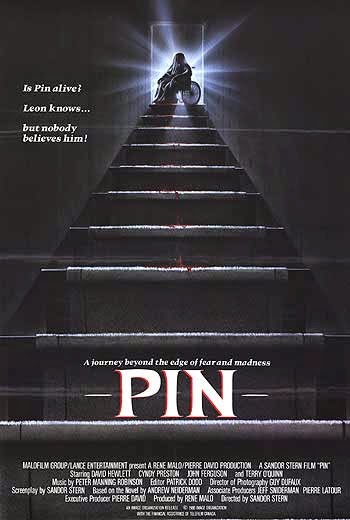
I had not heard of the 1988 horror film, "Pin," until I read one of those "14 Most Whatever Things That Will Make You Eat Cabbage and Want to Ride a Horse. Really, It's Actually That Awesome. Just Wait Until the Man Starts Singing. It Will Make Your Shoes Fly Off Your Head"-esque posts on Facebook. The list had something to do with 20 "Weird" Movies That You May Not Know. Indeed, I did not know about "Pin."
Based on the description of the film, I located a dvd of "Pin," and enjoyed what I saw.
"Pin" is written and directed by Sandor Stern who, previous to directing this film, wrote the screenplays of "Fast Break," the basketball movie starring Gabe Kaplan and the 1979 version of "The Amityville Horror." Prior to "Pin," he directed the pilot episode of the CBS tv series, "Cutter to Houston," and the tv movie, "John and Yoko: A Love Story," among other credits. Since "Pin," Stern has written and directed a menagerie of horror films, none of which have I seen. I have seen "Fast Break." I remember it appearing on the CBS Sunday Night, or possibly, Tuesday Night movie in the early 80's.
The story of "Pin" revolves around a doctor (the always interesting to watch Terry O'Quinn, who you may know from the very good film, "The Stepfather" and the tv show, "Lost," not the classic Al Adamson kid's film from 1981, which has been criminally removed from Netflix instant streaming) who uses a life-size human body model, which he names Pin, in his office, presumably to point out various ailments of his patients, but also serves as a parental reinforcement. Pin speaks, telepathically, to the children of the doctor and to the doctor. Pin is a member of the family, even though it is a medical tool. Yes, we have entered the fun world of the strange, bizarre, and unique in the world of cinema. Events happen which I will not give away. Pin continues to "live" with the brother and sister, Ursula and Leon (Cynthia Preston and David Hewlett) into their college years. Ursula understands that Pin is not a person, however, Leon has trouble comprehending this fact and treats Pin as a member of the family. Hilarity ensues and disturbing things occur involving Pin, Ursula and Leon and Bob and Carol, and Ted and Alice.
"Pin" had enough strangeness going on to keep me interested throughout. The performances by Preston and Hewlett are well done also. They both do a nice job of acting with a human body model and with each other, interpreting the uncomfortable dynamic between Ursula and her slightly off brother. Presumeably, there is a "Pinocchio" motif at work in the film, however, it seems to be hidden well and rarely referenced in the script. This is fine, as "Pin" works very well as simply the story of siblings and the weird presence of this "Pin" in their lives. I think you should pin it to your list of obscure, unique films to seek out and watch.
Monday, November 10, 2014
Whiplash Delivers Quite a Jolt
When reading this, please kind in mind that this is being written without the benefit of reading glasses. The fun of watching "Whiplash" comes from watching the dynamic performance of J. K. Simmons as Professor Kingsfield from "The Paper Chase" times fourteen. In "The Paper Chase," the film and the tv series, John Houseman's Professor Kingsfield, is a bit of a stone-cold teacher who does not tolerate incorrect answers due to lack of preparation on the part of his students and will scold his students in front of God and Kirk Cameron. In "Whiplash," Terence Fletcher, the bandleader/drumming instructor played by J.K. Simmons is a vulgar, unhappy asshole, but a fun asshole to watch. Fletcher would even tell you that he is a vulgar asshole. Simmons' performance is a lot of fun to watch, even as Fletcher yells obscenities at his students and brings some of them to tears with his insults. I understand that this is not some people's idea of entertainment, but I loved it.
Flether's goal is to make his players at the Shaffer Conservatory the best they can be, not a surprise in a film about drumming and the drive to make oneself as great as possible. Miles Teller is very good as Miles Nayman, the student Fletcher hears drumming in a practice room one morning and invites to try out for the school jazz band. "Whiplash" is the kind of film that demonstrates how I enjoy individual performances more than the overallness (I know that's not really a word) of any given film. Simmons is so charismatic and funny as he breaks down the young musicians he is trying to improve. Fletcher seeks perfection in them, not only for the students, but also for his reputation as an outstanding jazz conductor.
Another attribute of "Whiplash" are the absolutely energy filled, stirring jazz/drum performances that are featured throughout the film, including a fantastic ten or so minute finale. This film has a perfect ending, not simply as in I liked how the story ends (which I did), but in this case I mean that, technically and aesthetically, I love how the film concludes.
The only issue I have with the film is that I do not think that Fletcher would be able to get away with 95% of what he does and says in the film in our modern world of social media and lawsuits. Eventually a student would have recorded him verbally abusing somebody and posted it on You Tube. This is a certainty. This would seem to be a fairly large problem at the core of the film, the plausibility of any of this even having a chance of occurring, however, that doubtlessly being the case, the performance by Simmons and the powerful drama set forth by the intelligent script by Damien Chazelle, who also directs the film, made me learn to stop worrying and love this movie.
Flether's goal is to make his players at the Shaffer Conservatory the best they can be, not a surprise in a film about drumming and the drive to make oneself as great as possible. Miles Teller is very good as Miles Nayman, the student Fletcher hears drumming in a practice room one morning and invites to try out for the school jazz band. "Whiplash" is the kind of film that demonstrates how I enjoy individual performances more than the overallness (I know that's not really a word) of any given film. Simmons is so charismatic and funny as he breaks down the young musicians he is trying to improve. Fletcher seeks perfection in them, not only for the students, but also for his reputation as an outstanding jazz conductor.
Another attribute of "Whiplash" are the absolutely energy filled, stirring jazz/drum performances that are featured throughout the film, including a fantastic ten or so minute finale. This film has a perfect ending, not simply as in I liked how the story ends (which I did), but in this case I mean that, technically and aesthetically, I love how the film concludes.
The only issue I have with the film is that I do not think that Fletcher would be able to get away with 95% of what he does and says in the film in our modern world of social media and lawsuits. Eventually a student would have recorded him verbally abusing somebody and posted it on You Tube. This is a certainty. This would seem to be a fairly large problem at the core of the film, the plausibility of any of this even having a chance of occurring, however, that doubtlessly being the case, the performance by Simmons and the powerful drama set forth by the intelligent script by Damien Chazelle, who also directs the film, made me learn to stop worrying and love this movie.
Wednesday, November 5, 2014
Thanks Be To Bill Murray
"St. Vincent" is a very pleasant film starring Bill Murray as Vincent, a man of whom we learn a bit about during the course of the film, who is "befriended" by the boy who lives next door. Said boy, Oliver, played very well by Jaeden Lieberher, is a likeable character, not precociously delightful or mischievous, but more adult-like in his actions, which I appreciated. Oliver's mother, Maggie, played well by Melissa McCarthy, who it is nice to see not playing "the funny fat one," works hard at a hospital and needs somewhere for Oliver to stay after school. Vincent reluctantly agrees to babysit Oliver (for a fee) while Maggie is at work. Along the way, Vincent takes Oliver on trips to a racetrack, intervenes in a fight Oliver finds himself him with some school bullies, and introduces Oliver to his stripper girlfriend. After reading such a description, I normally would have found myself overwhelmingly not interested in seeing this film, however, the events in the film are presented in an intelligent way, so as not to distract from the sweetness at the core of the script. There are no gross jokes, no gross situations involving poop, semen, pee, or any other bodily fluids. Vincent is an angry, vulgar man, but he is likable, especially as we get to know more about him. By no means is Vincent perfect, but as portrayed by Murray, he is someone you will probably enjoy watching. Chris O'Dowd, who you may recognize from the British tv series, "The IT Crowd," has a wonderful supporting role as one of Oliver's teachers, Brother Geraghty. O'Dowd brings authority and humor to what easily could have been a throwaway role. It was nice to see the extent of the importance of his character to the film. In his first feature film, director Theodore Melfi, shows that he is capable of handling this task with ease and does not give in to the temptation of taking this material and story and turning it into a series of cheap jokes and incidents involving toilets. Instead, his film is engaging and smart. Not that toilet humor can't be funny if done intelligently (it can be done), but the course that "St. Vincent" could have taken could have been quite annoying and ridiculous. "St. Vincent" reminded me of films like "Little Miss Sunshine" and "The Way, Way Back," so if you enjoyed these films, I suspect that you will enjoy Bill Murray's latest film also.
Monday, July 28, 2014
Not Quite a Treasure, But Still a Bit of Fun
I am a sucker for movies with a gimmick or with any kind of kitsch value. “Treasure of the Four Crowns,” the 1983 3-D film that shamelessly rips of “Raiders of the Lost Ark” is very enjoyable even in 2-D as I watched the newly released dvd of the film. “Treasure” is on a new 4-movie dvd set along with the 1982 movie, “The Final Option.”
“Treasure of the Four Crowns” was Ferdinando Baldi’s second and last 3-D movie, following the 1981 film, “Comin’ at Ya,” which sounds like it could have easily been the title of the 3-D porn film, but that film was a 3-D spaghetti western. I recently saw “Comin’ at Ya” in a re-release back in 2012. The 3-D in the restored Real 3-D version of that film was pretty good, making for a fun experience. “Treasure of the Four Crowns” is not so much a good movie, as it is a fun experience for those who enjoy nostalgia from the 1980’s, especially the very narrow realm of 3-D cinema of the early 1980’s. Please continue reading this even if your interest in 3-D films of the early 80’s is minimal, if that. Or Manimal………….
“Treasure of the Four Crowns” tells the story of J. T. Striker (Tony Anthony) and the group of five he assembles to procure said four crowns of the film’s title from a castle somewhere in Spain. There are, of course, many obstacles to the procurement of these crowns, one of which is a flying key which tends to melt half of one’s face. The opening 20 minutes has no dialogue, which is fine, and introduces us to Striker by watching him elude one obstacle and flying sword after another. Soon enough, we meet the members of his intrepid team as he assembles them just short of classic Blues Brothers style. Unfortunately, “Four Crowns” contains no Aretha Franklin or Ray Charles numbers.
The enjoyment I gained while watching “Treasure of the Four Crowns” was from imagining what it would have been like to have many, many different objects thrust at me from the screen, such as birds, glass, a feather, a burning stick, and a female trapeze artist. “Four Crowns” throws enough things at the audience to have probably made it worth seeing when it was originally released, given that the 3-D was decent enough in the theater you attended.
I saw only one of the handful of 3-D movies that were released in the early 80’s upon their original release. I saw Jaws 3-D in 1983 at the General Cinema Irving Mall 1-3 with my friend, John. This was the same day my grandmother bought a 1978 Chevy Nova for my parents. Quite a monumental day it was. In my later years, I have seen “Comin’ at Ya” as noted above, “Friday the 13th Part 3,” “Parasite,” “Metalstorm,” “Amityville 3-D” and “The Man Who Wasn’t There.” The latter titles I have only seen in 2-D.
I enjoyed those films, as I enjoyed “Treasure of the Four Crowns,” as artifacts of a brief period in cinema history. You will not grow as a person or gain any insight into life by seeing these movies, but if you are interested in this particular subgenre, the new 4-movie dvd set which includes “Four Crowns” will be a purchase you will want to make.
Richard Linklater Has Been Anxiously Awaiting My Endorsement, So Here it Is
As an impressive achievement in filmmaking, Richard Linklater’s new film, “Boyhood,” succeeds tremendously. As a record of a boy and his family’s journey through twelve years of struggle and success, it succeeds even more so. Linklater’s film, made during a span of twelve years, using the same performers for the roles of the boy, his sister, his mother, and his birth father, impresses.
As the boy, Mason, Ellar Coltrane delivers an excellent performance as the film seamlessly transitions from one year in the boy’s life, starting at the age of 6, to his first year in college at age 18. If you were unaware that the film was made over the course of twelve years, you may not even notice how smooth the transitions from one year of filming to the next transpire.
“Boyhood” is not solely about Mason. The film also documents the struggles of Mason’s mother, played wonderfully by Patricia Arquette. We meet her as a late 20’s-ish college student who is a single mother to a woman who marries a jerk of an alcoholic college professor, to becoming a college professor herself.
As well, we watch as Mason’s birth father (Ethan Hawke) goes from an being aimless musician to an early 40’s year old man who eventually finds a steady career. Hawke’s character is a likeable one and a loving father, if a bit of a flake throughout a majority of the film. Lorelei Linklater, the director’s daughter, delivers a very good performance as Mason’s older sister, Samantha. Though her story is not the focus of the film, I was pleased that her character was not delegated to a background character, as would have been easy to do. One minor criticism of the film is that most of the men in Arquette’s life are assholes of one variety or the other. Of course, this part of the story structure allows the character of the mother to move from city to city, giving her and her son new life experiences. Still, the “jerk stepfather” trope is pretty tiresome and the audience has no choice but to dislike this guy, as well they should. The only “good guy” in her life is Mason’s father, however, it is only late in the film when he begins to display responsibility, likely added to his life by his second wife and a new child. Simply put, the men in “Boyhood” are not representative of what anyone wants to see in anybody. They are flawed beyond redemption of their sole volition. Though his character is a reprehensible ass, Marco Perella, delivers a great performance as the aforementioned college professor who marries Mason’s mother. There is nothing redeeming about this character at all, however, Perella portrays such a lack of redemption wonderfully. I really hated this guy, though, I kind of saw the direction of his storyline coming. I knew that less than halfway through the movie, Mason’s mother would not live happily ever after with that guy and that he would be exposed to be a jerk in some way or another. Maybe I just couldn’t relate to the instability of the mother character’s life since my parents have fortunately had a stable marriage for 45 years. I was just lucky. I understand that not all children are born of happy marriages and that single parenthood is almost as prevalent as two-parent family structures. My favorite scene in the film occurs near the end when, while the family is at lunch, a waiter reveals something to the mother. This scene made we smile quite widely. I wish there had been more scenes like this, however, the entire film as a whole, made me smile, especially after its satisfying conclusion which includes some gorgeous cinematography in Big Bend National Park. “Boyhood” succeeds in many ways, most of which is by its seamless transitions through time as we watch these characters age twelve years. It is a true cinematic achievement, which should not be forgotten when Oscar nominations are announced. The film has a true “indie” feel, with its location shooting in Texas and New Mexico, lack of big-name actors with the exception of Arquette and Hawke (similar to Steven Soderbergh’s 2005 film, “Bubble,” which you should see soon), and its simple, yet compelling storytelling aided by a great script and great performances. Keep in mind that the film is 165 minutes. It does not feel like a long film, however, if you do not have the patience for long films, try to put aside those feelings for this film. You may also want to empty your bladder before the film begins, preferably before the Fathom Events trailers start up, if not a little before then. Mine is just one of many positive endorsements of "Boyhood," so if you are of a mind to wait until I have said so (as so many people are, of course) let it be known that Linklater's film is well worth your time, whether you are able to get to it at the theater or watch it when it is released on dvd or blu-ray.
Wednesday, May 14, 2014
Shatner, 1970's, Kid's Movie, Dramatic Pauses....A Whale of a Tale
I did not know what to expect from the 1977 children's film, "A Whale of a Tale" starring William Shatner other than at least one great Shatner pause. Said Shatner pause from this film can be seen in the above clip. This is actually a collection of pauses, all in a brief 23 seconds. When I put the vhs tape I own into the vhs to dvd dubbing machine, I had no idea the extent to which I would be moved by greatness while watching this unknown kid's movie.
"A Whale of a Tale" was not as bad as I thought it was going to be, to borrow a phrase from my friend, KenAngryPuppyFilms. The film, directed by Ewing Miles Brown, tells the tale of Joey (Scott C. Kolden), a boy who wants to work at Marineland, a water park in Southern California. Marineland, a park similar to Sea World, located on the Palos Verdes peninsula in Los Angeles operated from 1954-1987. Thanks for the info, www.moderndayruins.com. Incidentally, Scott C. Kolden, since his acting career in the 1970's, has been a working sounds effects editor in Hollywood since the early 1990's. He has an impressive list of credits on IMDB. Good for him!
Joey is befriended by Louie (the usually crazy-haired comedian, Marty Allen, a staple of 70's game shows such as "The Hollywood Squares"), a fisherman who works at Marineland as a getter of whales. Allen's hair is, for the most part, restrained in this film. I do not know much about whaling, so I do not know if the treatment of the whales in this film is humane or not. Everything looked fine to me, but, since this film does not include any scenes detailing the ins and outs of whaling or other aspects of life on the sea like that one big book about the big whale does, we do not learn that much about whale capture from this film. I hate being decieved by a vhs cover box. So common back in the vhs era. That girl in the bikini never showed up in the film either.
Louie introduces Joey to Dr. Jack Fredericks (Shatner), a marine biologist at Marineland. Dr. Fredericks allows Joey to work at Marineland, giving him dull, repititive jobs to do, hoping that Joey will get bored and stop coming to the park. Alas, the opposite occurs. Joey's zeal for more interaction with the whales and this thirst for more knowledge of the world of marine biology increases. Dr. Fredericks recognizes this and allows Joey to stay. I liked this part of the script. Dr. Fredericks understands that Joey's interest in the whales could be the birth of a passion for his field and encourages Joey.
Despite the absence of whaling lessons or women in bikinis, "A Whale of a Tale" is a fairly straight-forward film. I expected many more scenes involving hindrances to characters trying to accomplish what they wanted to get done. There is one scene in which Marty Allen gets pushed into the water by a sea lion and alleged zaniness ensues. This scene hurt for a few seconds. Several minutes of running time are devoted to filmed accounts of the whale show at Marineland, which, for nostalgia's sake was of interest for a bit, however, after the 8th whale had jumped out of the water, I was ready for more of Shatner. Though not to the Fred Olen Ray-esque extent of time fill variety, scenes of 2 or 3 whales doing tricks goes a long way.
Joey's Aunt Meg (Nancy O'Conner) expresses concern about all the time he is spending at Marineland to Joey's mother, Anne (Abby Dalton). You may remember Dalton from her time on "Falcon Crest" in the 1980's. As expected, Anne meets Dr. Fredericks. Even in a kid's film, Shatner's character gets laid, even if it is just implied that the possibility for said action is inevitable, due to his character's charm. Nothing can stop the man! Maybe it was in his contract in the 70's and 80's that every character he plays, no matter the film, has the quality of being able to get the girl with absolutely no hindrances in his way.
In the third half of the movie, Joey runs away, or more precisely, boats away after his mother tells him that he can no longer work at Marineland. Joey is lost at sea. Dr. Fredericks, being the confident soul that he is, gathers a search team headed by zany Marty Allen and the search for Joey commences.
"A Whale of a Tale" is a pleasant film, worth watching for the presence of Shatner, the gorgeous Abby Dalton, a look at Marineland, a now gone memory of an interesting period of time, and for the uncomplicated structure of the story. It's not on dvd, however, you may be able to find a copy of it on vhs on Ebay or Amazon. I did not feel that I had had my 90 minutes stolen from me by this movie.
Subscribe to:
Posts (Atom)